Unlock these Enterprise features for free for 7 days:
Title: Acknowledgment by Notary Public
Document ID: 0
Document Completed:
No Document History |

Title: Acknowledgment by Notary Public
Document ID: 0
Document Completed:
No Document History |

The name of the person or company you'll enter will be used in the E-signature Agreement.
All signature fields must have an assigned signatory before the document can be sent for signing.
Please add signature fields and assign signatories before sending out the document.
The document will not be sent for signing.
Any changes to this document will require you to resend the document for signing.
All signatures on this document will be deleted and all signatories will be notified.
Document will only be sent to signatories who have not yet signed.
Copy the link
Your Session is already expired. Please login.

An Acknowledgment by Notary Public form is a legal form that is used by a notary public after notarizing a document in accordance with the Notary Consumer Disclosure. This form is used to declare that the notary public, or other officer completing this form, has verified the identity of the person who signed the document to which it is attached.
A notary public is a public officer who is authorized to act as an impartial witness to the signing of legal documents. The primary purpose of a notary is to verify the authenticity of a document and to prevent fraud. Other duties and responsibilities of a notary public include the following:
Some of the documents that require the services of a notary public are:
An Acknowledgment by Notary Public form is a one-page document. Do not leave the required items blank to avoid any problems with your document’s authenticity.
First Blank
Enter the county where the witnessed execution has taken place.
Second Blank
Enter the date when you signed this form.
Third Blank
Enter your full legal name and any title that accompanies your notary business.
Fourth Blank
Enter the full legal name of the witnesses present at the time of notarization.
Notarial Seal
Affix the official notarial seal.
Signature
Affix the signature of the notary public.
Description of the attached document
This section is optional.
Title or type of document
Enter the title or type of the document.
Date of document
Enter the date of the document.
Number of pages in the document
Enter the number of pages in the document.
Other
Enter other types of the attached documents, if applicable.
Capacity or capacities claimed by the signer or signers
Signer’s name
Enter the full legal name of the signer.
Mark the appropriate box or boxes to determine the capacities of the signer.
If you choose the first or last option, enter specific details.
Signer is representing:
Enter the full legal name of who the signer is representing.
A Notary Acknowledgment and a Jurat are some of the examples of notarial acts. A notarial act is any written narration of facts drawn up by a notary public.
A notary acknowledgment verifies that the person mentioned in the document is the same person who signed it. In this situation, the notary public's job is to confirm the identity of the signer. The notary public is merely verifying the identity of an individual who signed the document and is not testifying to the accuracy, legitimacy, or validity of the document’s content.
When a notary public is called upon to conduct a Jurat, the signer is required to take an oath or affirmation. In this situation, the notary public's job is to deliver an oath or affirmation. A jurat adds another level of security by requiring a person to sign the document in front of a notary public and swear that they are doing so willingly and voluntarily.
Notarization is a process where a notary public certifies the legitimacy and proper execution of documents in order to prevent fraud. Here are some of the reasons why notarization is important:
Step 1: Bring the unsigned and complete documents to a notary public.
It is important to make sure that you have completed the necessary documents that will undergo notarization. Ensuring that you’ve already completed the documents will speed things up. It is also strongly advised that the documents be signed in the presence of a notary public.
Step 2: Take all the signers to the notary public’s office.
The people who are expected to sign the document must appear and be present at the time of notarization. Signers must be of legal age, 18 years old and above. Signers should also bring proof of identity in order for the notary public to properly verify their identities.
Step 3: Sign the document.
After the notary public has checked your documents and identification, you will be asked to sign the document. The notary public will be an impartial witness to the signing of documents. He or she will also observe if you’re being forced to sign the documents against your will.
Step 4: The notary public will sign and stamp the document.
To officially and completely notarize a document, the notary public must affix his or her signature on the said document. He or she will also stamp it with a notary seal, his registration number, and date to prove that your document is notarized.
Step 5: Distribute the original copies.
It is advisable that the parties involved must have their own original copy of the notarized document with the official notarial seal of acknowledgment. In the event that the document is violated or needs to be given to a third party, this will ensure that each individual has an approved copy.
PDFRun is an online PDF editor platform that enables its users to find, edit, electronically sign, download, and share forms and documents anytime and anywhere, using any device.
With a cloud-based archive of thousands of forms and documents, it fast-tracks the document management processes of many professionals and businesses of different sizes, across many industries.
Through its user-friendly and easy-to-navigate interface, users may also upload their own files to fill out, edit, convert, e-sign, and share to multiple recipients to request signatures.
PDFRun streamlines document management processes, improves documentation workflows, and enhances its users’ efficiency, resulting in better productivity and an increase in work output.
1-888-245-8984
Monday - Friday
7:00AM to 4:00PM PST
Use the File button to access functions such as New PDF, New Page, Organize Pages, Save, Save As, Print, Export, Share Link, Email, and Postal Mail.

Use the Text button to add texts, numbers, and symbols to your document. To customize the texts, you will be able to access additional tools, such as the Bold, Italics, Underline, and Strikethrough buttons, the text alignment options, such as Left, Center, Right, and Justified buttons, the Bulleted List and Numbered List buttons, the Font Styles and the Font Sizes drop-down lists, and the Font Color and Font Highlight Color selection tools.
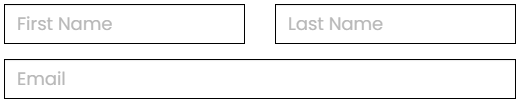
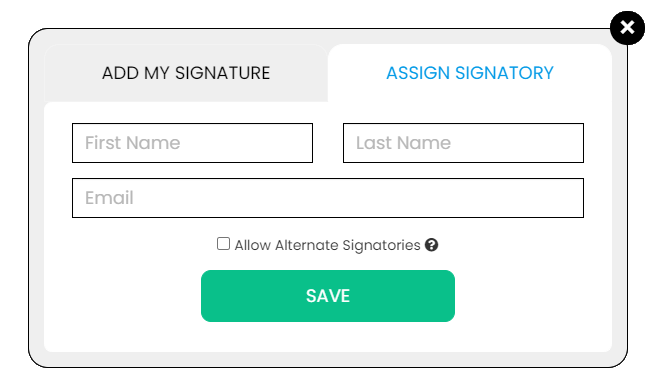
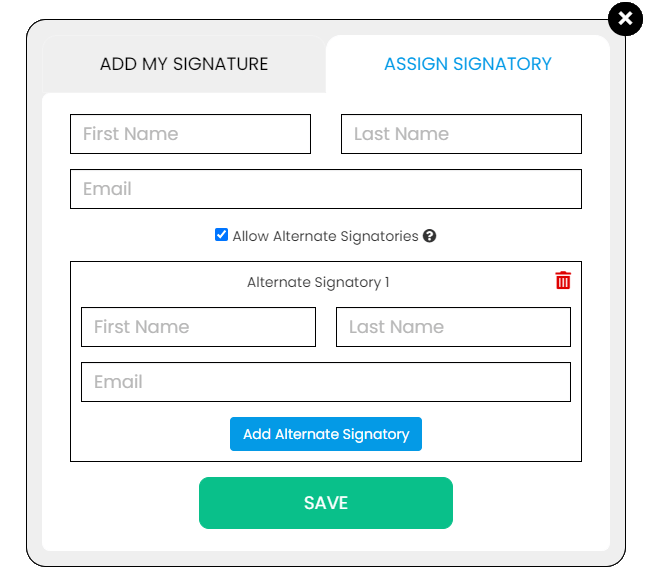
Use the Signature button to add a signature to your document and to assign a signatory. You will have the option to Type, Draw, or Upload your signature.

Use the Image button to add an image, logo, or photo to your document. The accepted formats are .jpg, .jpeg, and .png.

Use the Date button to add a date to your document. The default date format is MM/DD/YYYY, but you can modify it by typing the date format you prefer. Initially, it will display the current date, but you will be able to change it. To customize the date, you will be able to access additional tools, such as the Move text button, the Font Styles and the Font Sizes drop-down lists, the Bold, Italics, and Underline buttons, and the text alignment options, such as Left, Center, Right, and Justified buttons.
Use the Check button to add a check symbol to your document. To customize the check symbol, you will be able to access the Size adjustment tool.

Use the Cross button to add a cross symbol to your document. To customize the cross symbol, you will be able to access the Size adjustment tool.

Use the Whiteout button to white out or erase items in your document.
Use the Redact button to censor items in your document.

Use the Marker button to highlight items in your document. To customize the marker, you will be able to access the Color selection and Size adjustment tools.

Use the Insert button to add Icons, Header, Footer, Watermark, Comment, and Sticky Note to your document. The Icons button allows you select shapes such as Arrow Left, Arrow Right, Arrow Up, Arrow Down, Thumbs Up Thumbs Down, Question Mark, Exclamation Point, Circle, and Square; the Header button allows you to add a header; the Footer button allows you to add a footer; the Watermark button allows you to add a watermark by typing or uploading an image; the Comment button allows you to leave a comment in any part of the document; the Sticky Note allows you to post a note to any part of the document.

Use the Zoom button to zoom in and zoom out your document.
Use the Undo button to negate the last command done to your document.

Use the Redo button to reverse your last Undo.

Use the Help button to read instructions about how to use PDFRun’s online editor.

Use the Send for Signing button when you are done editing your document and you want to send it to another person for signing. You will need to provide the information of the recipient of your document to proceed.

Use the Email button when you are done editing your document and you want to send it to another person via email. You will need to provide the information of the recipient of your document to proceed.

Use the Download button when you are done editing your document and you want to save a copy of it to your device.

Use the Done button to finish editing your document.